Skip hours of research. Our experts have tested dozens of trading bots so you don’t have to. Answer 6 quick questions and get a personalized recommendation based on your trading style and goals.”
0DTE Options Trading Bots: How to Automate Same-Day Expiration Strategies
Zero-days-to-expiration options — 0DTE for short — now account for more than half of all SPX options volume on a typical trading day. That shift has happened fast, and it has pulled a lot of retail traders into a format that punishes hesitation and rewards precise, repeatable execution. This is exactly the kind of environment a 0DTE options trading bot is built for. This guide covers how these bots work, which strategies they run best, what to look for in a platform, and the risk controls that separate traders who last from traders who blow up an account in a single session.
What Is a 0DTE Options Trading Bot?
A 0DTE options trading bot is an automated system that opens and closes options positions on contracts expiring the same day, following a fixed set of rules instead of manual clicks. Because 0DTE contracts can swing from worthless to deep in-the-money within minutes, the entire trade lifecycle — entry trigger, strike selection, position sizing, and exit — has to happen faster than most humans can manage by hand while also watching a screen for eight hours straight.
These bots typically connect to a broker through an API, watch for a defined signal (a price level, a technical indicator, a time-of-day trigger, or an options-flow anomaly), and then place, manage, and close trades automatically. Some platforms, like OptionBots, let traders build this logic visually without writing code, which has opened up 0DTE automation to people who understand the strategy but not Python.
Why 0DTE Strategies Are a Good Fit for Automation
0DTE options decay on a compressed timeline. Theta, the rate at which an option loses value as expiration approaches, accelerates sharply in the final hours of a same-day contract. That creates two problems for manual traders: entries need to happen at precise moments, and exits need to happen just as precisely to lock in gains or cut losses before a position craters.
A bot removes the emotional lag between "I should probably close this" and actually clicking the button. It also lets a trader run a strategy that fires on a specific time-of-day window — say, the first 30 minutes after market open or the final hour before the close — without staring at a chart for that entire window every single day. This is the same reason automated systems have taken hold in scalping and momentum strategies, just compressed into a single trading session instead of spread across days.
Common 0DTE Strategies Bots Run
Most 0DTE automation falls into a handful of well-tested structures rather than exotic one-off setups:
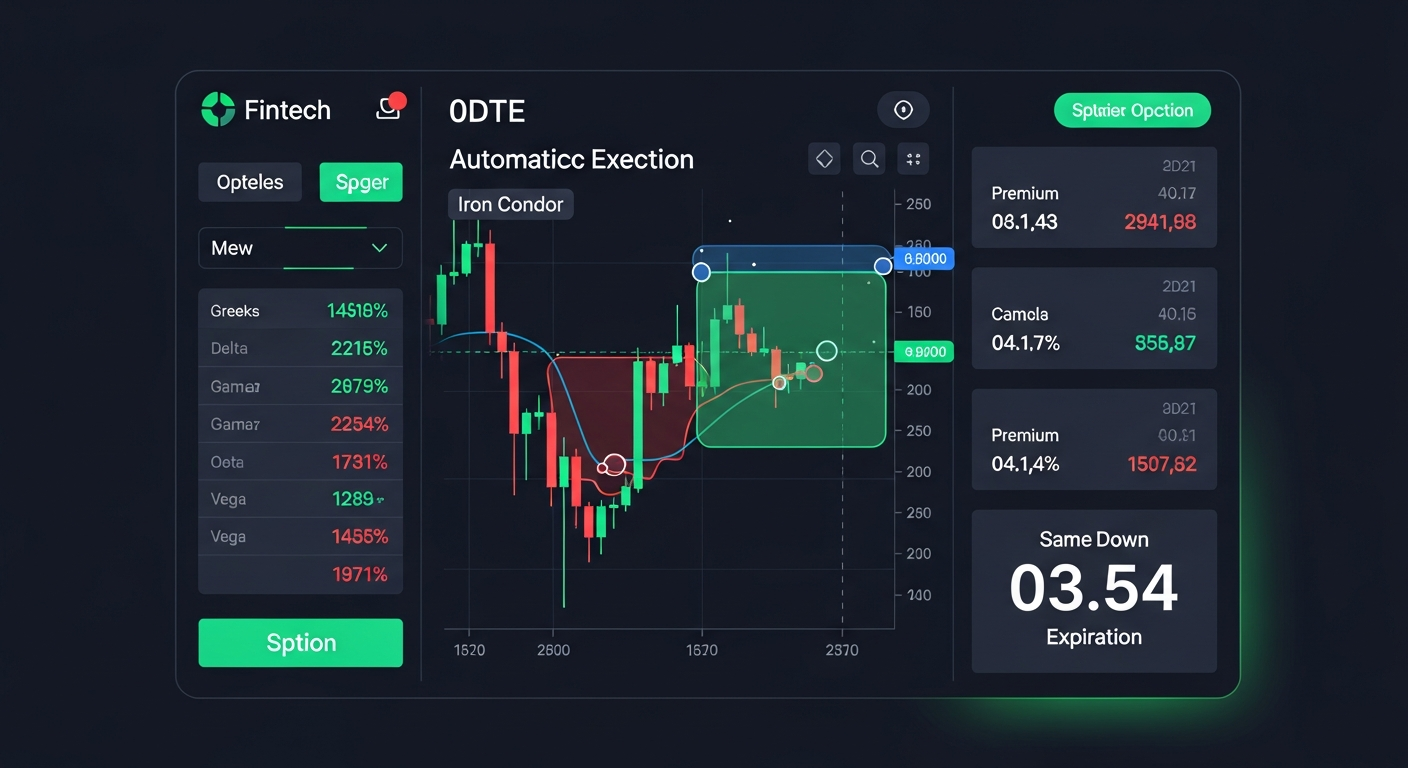
Iron condors. A bot sells a call spread and a put spread around the current price, collecting premium on the bet that the underlying stays within a range through expiration. Because 0DTE iron condors have almost no time value cushion, entry timing and strike distance from the current price matter enormously — a job well suited to rules a bot can apply consistently.
Opening range breakout (ORB). The bot defines a price range from the first few minutes of trading, then enters a directional 0DTE position if price breaks above or below that range. This strategy depends on immediate, mechanical execution the moment the breakout condition is met.
Credit spreads on defined delta. Rather than picking strikes by eye, a bot can be programmed to sell spreads at a specific delta (say, the 10-delta strike) automatically re-selected each morning based on that day's implied volatility, keeping the risk profile consistent even as the market moves.
Time-based scaling exits. Because 0DTE decay is nonlinear, some bots use tiered exit rules — take partial profits at a set percentage gain, then tighten the stop as expiration approaches — rather than a single fixed take-profit target.
Risk Management Is Non-Negotiable With 0DTE
Get the Top 5 Bots for Early Retirement report:
Same-day expiration options carry a risk profile that is fundamentally different from monthly or weekly contracts, and it's worth being blunt about it: a poorly managed 0DTE bot can lose a meaningful percentage of an account in a single afternoon. A few controls matter more here than anywhere else in automated trading.
Position sizing has to be set as a small, fixed percentage of account equity per trade, not a static contract count. A five-lot iron condor might be reasonable sizing on a $50,000 account and reckless on a $5,000 one, and 0DTE's speed means there's no time to notice the mismatch mid-trade. Our guide on position sizing in trading bot strategies walks through the specific methods worth configuring before going live.
Hard stop-losses need to be baked into the bot's logic, not treated as a manual backstop, since 0DTE moves can outrun a trader's ability to intervene. A daily maximum-loss circuit breaker — a rule that shuts the bot down entirely once a set dollar or percentage loss is hit for the day — is one of the simplest and most effective safeguards available, and it's covered in more depth in our trading bot risk management guide.
It's also worth reading up on what happens during sudden volatility spikes, since 0DTE contracts are disproportionately exposed to sharp intraday moves. Our piece on trading bots and black swan events covers how automated systems behave when markets move faster than their assumptions expect.
Broker and Platform Requirements
Not every broker supports the combination of options approval level, API access, and execution speed that 0DTE automation requires. Tastytrade and Tradier are both commonly used because they offer developer-friendly APIs alongside options trading, and we've published step-by-step setup guides for both: connecting Tastytrade to a trading bot and connecting Tradier to a trading bot. Robinhood has more limited API access for automated options trading, so traders building 0DTE systems typically look elsewhere for the execution layer even if they hold other positions there.
Before any of this matters, a trader needs options trading approval at the level their broker requires for spreads (typically level 2 or higher), since 0DTE iron condors and credit spreads won't execute without it.
Backtesting 0DTE Strategies Before Going Live
0DTE strategies are especially prone to overfitting because a small sample of trading days can look deceptively strong or weak. A strategy that wins nine days out of ten in a quiet market can lose all nine days' worth of gains in a single volatile session. Our guide on how to backtest a trading strategy explains how to build a testing window that includes both calm and turbulent conditions, which matters more for 0DTE than almost any other strategy type given how sensitive same-day options are to volatility regime.
Paper trading for at least a few weeks across different market conditions — not just a strong trending week — is worth the delay before committing real capital. See our breakdown of paper trading for how to structure that testing phase properly.
Getting Started the Right Way
Traders new to 0DTE automation are generally better off starting with a single, simple structure — an iron condor or a defined-delta credit spread — on a small position size before layering in additional strategies or increasing size. Platforms like OptionBots are built specifically for traders who want to construct and backtest 0DTE logic visually rather than code it from scratch, which lowers the barrier to entry without removing the need for careful testing.
The takeaway: 0DTE options trading bots can execute strategies with a speed and consistency manual trading can't match, but the same compressed timeline that makes automation valuable also makes risk management the deciding factor between a durable system and an expensive lesson. Start small, backtest across varied market conditions, and build in hard stop-losses before ever running a 0DTE bot with real money.
Free Report
Before You Choose a Bot, Read This
Get our free Top 5 Bots for Early Retirement report plus The Bot Report newsletter — the bots we'd actually trust to compound over the long term.
Written by
Amara Okafor
8 min read
Amara Okafor is an investment analyst and writer exploring how automation, AI, and disciplined risk control intersect for modern traders.
How to Choose the Best Trading Bots for Your Strategy
Take our free quiz to show how to pick bots that actually work for you
Get My Free Bot Report
Get Our Expert Bot Recommendation
Skip hours of research. Our experts have tested dozens of trading bots so you don’t have to. Answer 6 quick questions and get a personalized recommendation based on your trading style and goals.”
Join The Bot Report newsletter and get our free guide to the five trading bots most likely to help you retire early — backed by real reviews and verified performance.