Skip hours of research. Our experts have tested dozens of trading bots so you don’t have to. Answer 6 quick questions and get a personalized recommendation based on your trading style and goals.”
Swing Trading Bots: How to Automate Your Swing Trading Strategy in 2026
Most traders who try to automate their strategy immediately think about scalping or day trading — high frequency, rapid execution, constant monitoring. But for traders who prefer holding positions for days or weeks, swing trading bots offer a very different kind of automation: one that's calmer, more forgiving of execution timing, and often more accessible to retail traders who aren't running institutional-grade infrastructure.
This guide covers how swing trading bots work, the indicators they rely on, the platforms best suited for automated swing trading, and what you need to get one running in 2026.
What Is a Swing Trading Bot?
A swing trading bot is an automated system designed to enter and exit positions over a multi-day to multi-week timeframe, capturing "swings" in price — the natural push-and-pull movement between support and resistance, overbought and oversold conditions, or trend legs and pullbacks.
Unlike scalping bots that might execute hundreds of trades per day, a swing trading bot might place two or three trades per week. The holding period is longer, the position size can be larger relative to account size, and the strategy doesn't depend on millisecond execution speed.
This makes swing trading a natural fit for automation. Because the timeframes are daily and weekly charts rather than 1-minute or 5-minute charts, the bot has time to properly evaluate signals, confirm conditions, and execute without the execution-speed pressure that makes day trading bots more technically demanding to deploy.
Why Automate Swing Trading?
Manual swing trading has one consistent enemy: inconsistency. Traders find a setup, hesitate, miss the entry. Or they exit early because a position moved against them briefly, then watch the trade go on to hit their original target. Emotion is the biggest performance leak in manual swing trading.
A bot removes that completely. Once you define your entry rules, exit rules, stop-loss placement, and position size, the bot executes exactly those rules — every time, without second-guessing. If your strategy has an edge, a bot expresses that edge more consistently than you can manually.
There are other practical benefits too. A swing trading bot can monitor dozens of instruments simultaneously — something impossible to do manually across multiple watchlists. It can also set limit orders at precise levels and wait for price to come to them, which is harder to do consistently when you're managing a full watchlist by hand.
The Indicators Swing Trading Bots Rely On
Swing trading bots are rule-based systems, so the quality of the strategy is determined by the indicators and conditions you program into it. These are the most commonly used:
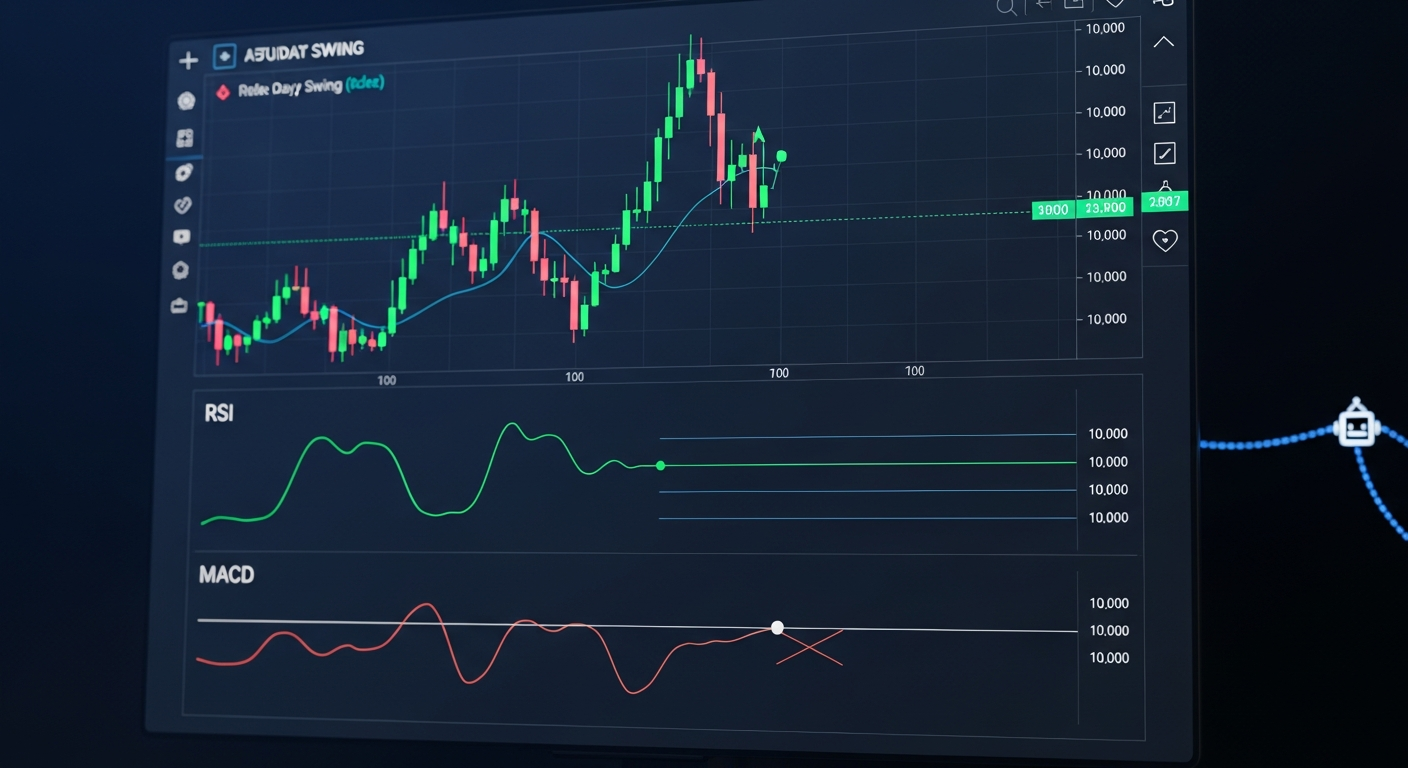
RSI (Relative Strength Index) RSI measures momentum on a scale of 0–100. The standard interpretation: readings below 30 are considered oversold (potential buy zone), and readings above 70 are considered overbought (potential sell zone). For swing trading, the 14-period RSI on a daily chart is the most common configuration. Bots use RSI to identify when a pullback in an uptrend has gone far enough to offer a re-entry opportunity.
MACD (Moving Average Convergence Divergence) MACD tracks the relationship between two exponential moving averages — typically the 12-period and 26-period EMA — and generates a signal line from their difference. Bullish MACD crossovers on the daily chart are a common swing trading entry trigger. The MACD also helps confirm trend direction, which matters when you're holding a position for multiple days and need confidence that momentum is on your side.
Moving Averages (20, 50, 200 EMA/SMA) Moving averages are the backbone of most swing trading setups. The 20-period EMA acts as a dynamic support level in trending markets. The 50-period moving average is used to filter trades — many swing bots only take long positions when price is above the 50-day MA, and short positions when it's below. The 200-period MA is the longer-term trend filter. A stock trading above its 200-day MA is considered in a long-term uptrend; below it, a downtrend.
Bollinger Bands Bollinger Bands measure volatility. When price compresses near the middle band (low volatility) and then expands outward, swing bots can interpret this as the start of a new directional move. Band touches at extremes are also used as mean-reversion signals, but on longer timeframes.
Volume Volume confirms price moves. A swing trading bot that sees a breakout on low volume may filter that trade out entirely. Most well-constructed swing bots require volume to be above its 20-day average before triggering an entry on a breakout setup.
The most reliable swing trading bots typically combine at least two of these — for example, an RSI oversold reading that coincides with a bullish MACD crossover on a stock above its 50-day MA. The more conditions that must align, the fewer (but higher-quality) signals the bot generates.
Common Swing Trading Bot Strategies
Trend Pullback Entry The bot identifies assets in a clear uptrend (price above 50 and 200 MA), waits for a pullback to the 20 EMA or a key support level, and enters when RSI recovers from oversold conditions. The target is the prior high; the stop is below the recent swing low.
MACD Crossover Strategy The bot monitors daily charts for bullish MACD crossovers — when the MACD line crosses above the signal line from below zero. Combined with an RSI that isn't already overbought, this is a simple and widely used swing entry signal. The logic: momentum has shifted, and you want to be long before the broader move continues.
Breakout Swing Entry The bot monitors for consolidation ranges — periods of tight price action where the stock trades between clear support and resistance for multiple days. When price breaks above resistance on above-average volume, the bot enters. Targets are set using the height of the range projected upward. This is particularly effective for stocks in earnings recovery or following a catalyst.
Oversold Bounce in an Uptrend This is a hybrid of mean reversion and trend following. The bot only trades stocks in long-term uptrends (above 200 MA), but waits for a short-term RSI reading below 30 to indicate a temporary selling flush. It then enters on the first sign of recovery. Risk is low because the overall trend context is bullish.
Best Platforms for Automated Swing Trading in 2026
Get the Top 5 Bots for Early Retirement report:
Unlike scalping bots that require co-located servers and ultra-low latency brokers, swing trading bots work well across most major automated trading platforms. The key requirements are: reliable API access, stable order execution, and good backtesting tools.
TradingView + Webhook Integration If you already use TradingView for technical analysis, it's one of the most accessible paths to swing trading automation. You write your strategy in Pine Script, set up alerts that fire when your conditions trigger, and route those alerts via webhook to a broker execution layer. Platforms like TradersPost serve as the middleware that receives the alert and places the order at your broker.
Alpaca Alpaca is a commission-free US stock and ETF broker with a clean REST API, a paper trading environment, and documentation designed for algorithmic traders. It's a strong choice for equity swing trading bots — especially for traders who want to code their own bot logic in Python and connect directly to their brokerage account without an intermediary platform.
Interactive Brokers Interactive Brokers is the go-to for traders who need access to a wide range of instruments including international stocks, options, and futures alongside equities. The TWS API and IB Gateway are well-documented and support sophisticated order types, which is useful for swing strategies that use trailing stops or bracket orders.
Tastytrade and Tradier (for Options Swing Trading) If your swing strategy involves options — buying calls or puts at turning points, or selling premium during consolidation — Tastytrade and Tradier both offer API access that works well with swing-style options automation.
How to Set Up a Swing Trading Bot: The Core Process
Step 1: Define your strategy in exact rules Before touching any platform, write your complete strategy in plain English. "I buy when RSI crosses above 35 from below, MACD is on a bullish crossover, and price is above the 50-day EMA" is a strategy. "I buy when it looks good" is not. The bot can only implement what you can define with precision.
Step 2: Backtest on historical data Run your rules against at least 2–3 years of historical data across multiple market conditions — trending markets, choppy markets, and crash periods. Look at win rate, average win vs. average loss, maximum drawdown, and Sharpe ratio.
Step 3: Paper trade for 4–8 weeks Deploy the bot in paper trading mode with your full strategy rules. Monitor it daily. You're looking for execution behavior that matches your backtest, and watching for edge cases your backtest didn't catch — things like earnings gaps, halted stocks, or liquidity gaps at stop levels.
Step 4: Go live with reduced size Your first 60 days live should be at 25–50% of your intended position size. This gives you real-world execution data without full risk exposure while you validate that live performance tracks your paper trading results.
Step 5: Monitor and maintain Swing trading bots don't need minute-by-minute attention, but they do need regular reviews. Check open positions daily, review weekly performance, and audit your strategy quarterly.
Swing Bots vs. Day Trading Bots: What's Right for You?
The right choice depends on your capital, time, and risk tolerance.
Swing trading bots are better suited for traders with smaller accounts (under $25,000) who want to avoid pattern day trader restrictions, traders who don't want to babysit a bot during market hours, and anyone whose strategy is built on daily or weekly chart signals rather than intraday noise.
Day trading bots are better for traders with higher capital who want faster feedback loops and can handle the complexity of intraday execution. They also require more infrastructure and often more hands-on oversight.
For most retail traders, swing trading automation is the more practical starting point. The slower pace, larger signal timeframes, and broker flexibility make it easier to implement and iterate on a strategy without the operational overhead that comes with high-frequency automation.
Risk Management for Swing Trading Bots
Because swing positions are held overnight and across multiple days, they're exposed to gap risk — price can open significantly above or below your stop level. Your bot won't protect you from a 10% gap-down on a bad earnings report if you're holding through the event.
The main risk controls for automated swing trading:
Stop losses on every trade — usually placed below the recent swing low or a structural support level
Avoid holding through earnings — program your bot to close positions before a stock's earnings date or to alert you to do so manually
Position sizing discipline — most swing traders risk 0.5–2% of account equity per trade
Max open positions — cap how many positions the bot can hold simultaneously to limit concentrated gap risk
The Bottom Line
Swing trading is one of the most automation-friendly strategies available to retail traders. The longer holding periods reduce execution pressure, the indicator-based rules translate cleanly into bot logic, and the trade frequency is low enough to be manageable even for traders new to automation.
The setup process is straightforward: define your rules precisely, backtest them thoroughly, paper trade before committing capital, and start live with reduced size. The traders who struggle with swing trading bots are usually the ones who skip the testing phase or deploy a strategy that was never properly defined to begin with.
Free Report
Before You Choose a Bot, Read This
Get our free Top 5 Bots for Early Retirement report plus The Bot Report newsletter — the bots we'd actually trust to compound over the long term.
Written by
Olivia Bennett
8 min read
Olivia Bennett is a financial writer and former brokerage product manager who evaluates platforms through the lens of fees, reliability, and user experience.
How to Choose the Best Trading Bots for Your Strategy
Take our free quiz to show how to pick bots that actually work for you
Get My Free Bot Report
Get Our Expert Bot Recommendation
Skip hours of research. Our experts have tested dozens of trading bots so you don’t have to. Answer 6 quick questions and get a personalized recommendation based on your trading style and goals.”
Join The Bot Report newsletter and get our free guide to the five trading bots most likely to help you retire early — backed by real reviews and verified performance.