Skip hours of research. Our experts have tested dozens of trading bots so you don’t have to. Answer 6 quick questions and get a personalized recommendation based on your trading style and goals.”
Best Secrets Managers for Trading Bot API Keys in 2026
The best secrets managers for trading bot API keys in 2026 depend on where your bot runs, how it authenticates and who must maintain its credentials. This comparison covers AWS Secrets Manager, Azure Key Vault, Google Cloud Secret Manager, Doppler and Infisical. All five manage credentials; none is a trading bot, a broker integration or a promise that an account cannot be compromised.
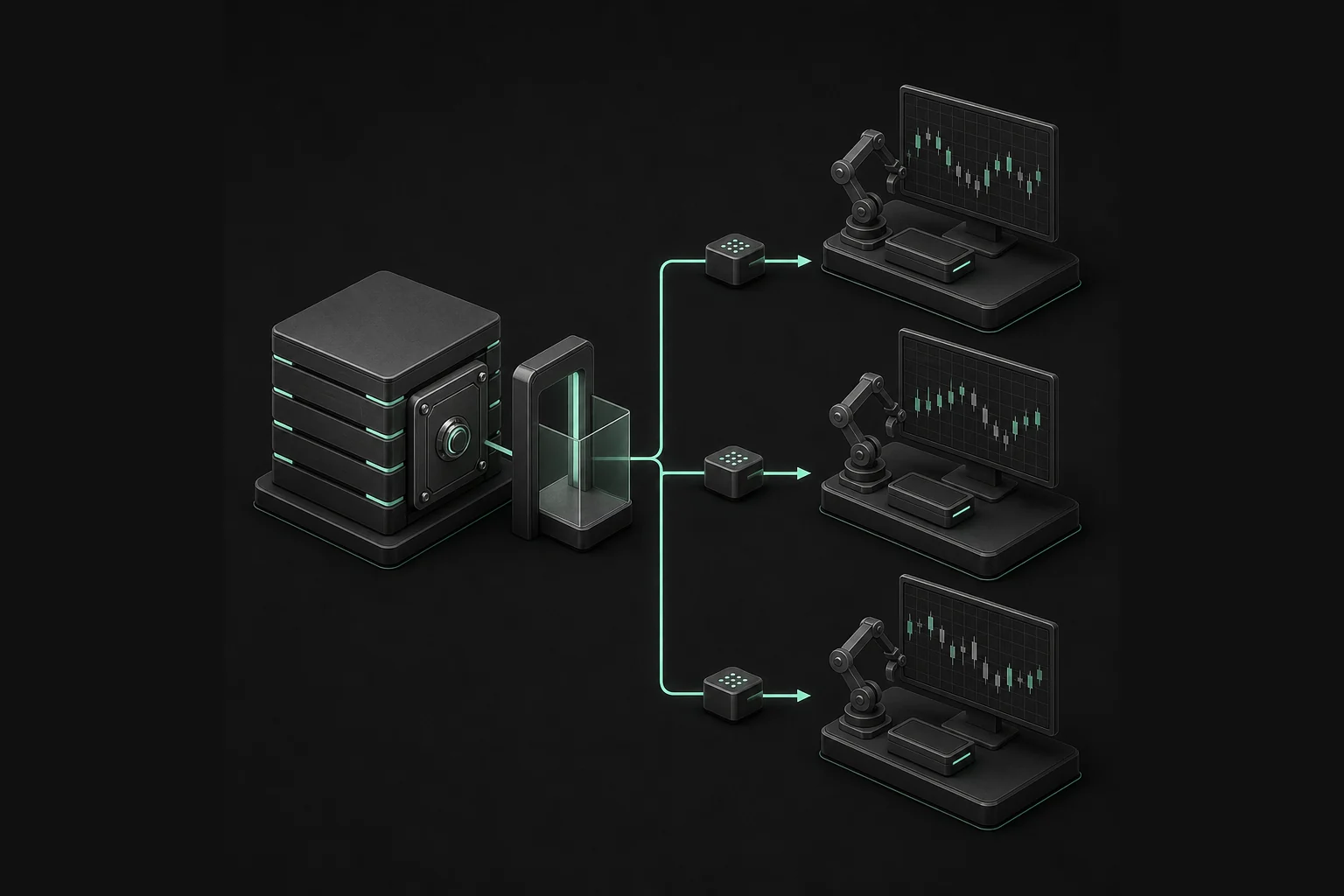
Start with the boundary between storing a credential and authorizing a trade. An API key vault can control which worker retrieves trading bot credentials. It does not set withdrawal permissions, position size or trading authority at your exchange. Configure those separately, use the minimum permissions your strategy needs and separate test accounts from live accounts. Our trading bot API explainer covers the connection itself; this guide addresses how its sensitive inputs reach the application.
Write down your hosting platform, worker count, operators, deployment environments and recovery owner before choosing a service. A small AWS worker and a multi-cloud team have different authentication and support needs. Count machine identities alongside people. Ask how a fresh worker obtains its first credential without embedding another permanent secret in source code. Prefer supported workload identities where appropriate, and keep credentials out of browser bundles, exception reports and build logs.
Then define what happens during a vault outage or credential change. Retrieval on every order can create an unnecessary dependency; an indefinite cache can retain revoked credentials. Your application needs bounded caching, expiration rules and a tested response to access failure. These are design choices, not benefits established by a vendor logo. This guide compares documented capabilities and costs, not penetration-test results or measured trading latency. Use it to shortlist a service, verify regional and account eligibility, and plan a paper-environment trial before changing a live worker.
Quick Answer
1. AWS Secrets Manager
Best for: AWS-native workers. It provides runtime secret retrieval with IAM access controls and documented rotation workflows.
2. Azure Key Vault
Best for: Azure-native applications. It stores application secrets and controls authenticated access to specific secret versions.
3. Google Cloud Secret Manager
Best for: Google Cloud workers. It provides versioned secrets, IAM controls and global or regional service options.
4. Doppler
Best for: multi-environment development teams. Its dashboard, CLI and integrations support centralized secrets delivery.
5. Infisical
Best for: teams evaluating managed delivery versus self-hosting. Its platform supports human and machine identities, with controls that vary by tier.
How we compare secrets managers for trading bot API keys
We reviewed the linked official pricing and documentation on October 4, 2026. Criteria were cloud/workload fit, machine identity authentication, IAM/access controls, secret versioning, deployment synchronization, secrets rotation support, audit history, regional availability, setup and maintenance, outage/recovery design, support and total cost. The order reflects workflow fit, not a scored security ranking.
This is documentation-based research: no penetration, latency, paid-account, support-response or operational testing was performed. Official pages returned HTTP 200 during verification. Infisical's pricing extractor failed, but its page loaded directly; overlapping monthly/annual paid figures are deliberately not quoted. Public documentation does not confirm your account eligibility, residency requirements, broker compatibility or negotiated support terms.
Secrets managers for trading bot API keys: comparison table
Swipe horizontally, or focus this table and use Left/Right arrows. End reaches Pricing; Home returns to Tool.
Tool
Best For
Strength
Limit
Pricing
AWS Secrets Manager
AWS workers
IAM and runtime retrieval
Broker rotation needs verification
Examples: $0.40/secret/month + $0.05/10,000 calls
Azure Key Vault
Azure applications
Identity-controlled secret access
Keys and secrets are different products/features
Listed secrets rate: $0.03/10,000 operations
Google Cloud Secret Manager
GCP workers
Versioning and replication choices
Versions and locations affect cost
Free allowances; example $0.06/version/location/month
Free: 5 identities; paid per identity, confirm billing
1. AWS Secrets Manager
Best for: bots already using AWS workloads and IAM administration.
Features: The official overview describes storing application credentials and API keys, retrieving them at runtime and configuring rotation. This removes the need to embed the broker credential in source, but the calling workload must still authenticate and receive narrowly scoped access. Plan secret versions and rollout procedures with your deployment owner.
Limits: A rotation schedule does not prove that AWS can issue a replacement API key at your broker. Confirm supported rotation targets or implement and validate the required broker-side workflow. Check regional service availability and account eligibility. Logging, recovery permissions and on-call ownership require configuration; centralized storage does not establish a complete incident response.
Pricing: The official examples use $0.40 per secret/month plus $0.05 per 10,000 API calls. Customer-managed KMS keys, Lambda rotation and other services may add charges. Confirm region, replicas, request volume and support costs rather than treating the example as a universal quote.
Choose if: AWS workload authentication is already part of your operating model. Avoid it if your team cannot maintain IAM policies and expects storing a key to automatically rotate it at every exchange.
2. Azure Key Vault
Best for: Azure-native applications with an established identity and access model.
Features: Microsoft's Key Vault overview describes centralized storage for tokens, passwords and API keys. Applications retrieve secrets through URIs, including specific versions. Authentication and authorization are separate checks; logging can record access activity. Separate vaults and permissions can limit which application reads a trading account's credentials.
Limits: Distinguish secrets from cryptographic keys, certificates and Managed HSM. Cryptographic-key rotation is not exchange credential replacement. Confirm supported regions, network access, recovery behavior and administrative permissions for your subscription. Verify logging retention and support arrangements; access to a service does not itself satisfy an audit requirement.
Pricing: The retrieved official pricing table lists $0.03 per 10,000 secret operations. Qualify that figure by currency, region and customer agreement. Other operation types and services have different charges; do not use certificate, HSM or key-rotation prices to estimate ordinary secret reads.
Choose if: your bot and operators already use Azure identities. Avoid it if you need a ready-made broker credential lifecycle without verifying the external provider's supported replacement and revocation processes.
3. Google Cloud Secret Manager
Best for: Google Cloud workloads needing explicit version and replication choices.
Features: The official overview documents secret versions, granular IAM access, replication and separate global/regional service options. Versions support controlled rollout and rollback, but reverting stored data cannot restore a credential already revoked at the exchange. Select locations based on operational and residency requirements, not just the smallest bill.
Get the Top 5 Bots for Early Retirement report:
Limits: Enabled and disabled versions count as active for billing. User-managed replication can add location charges. A rotation notification is a message to another system, not proof that a broker key was replaced. Confirm global versus regional feature availability, workload authentication and required recovery access.
Pricing:Official allowances include six active versions, 10,000 access operations and three rotation notifications monthly, aggregated by billing account. Published examples use $0.06 per active version/location/month and $0.03 per 10,000 excess access operations. Automatic replication is billed as one location. Check current billing units, other services and support charges.
Choose if: GCP is your existing platform and you can manage versions and locations deliberately. Avoid it if you assume disabled versions are free or a scheduled notification completes broker-side rotation.
4. Doppler
Best for: teams coordinating secrets across development and multiple deployment environments.
Features: The official documentation describes a CLI, access controls, logs, versioning and infrastructure integrations. Its workflow can fit teams that want a shared configuration interface rather than separate cloud-specific administrative routines. Verify that your actual deployment target has a supported integration and that workers can authenticate appropriately.
Limits: Syncing a configuration does not necessarily restart an application or replace a value already cached in memory. Confirm refresh behavior, service-token handling, log retention and rotation targets. Do not assume data residency, integrations or Enterprise features apply to every plan.
Pricing: The current pricing page lists Developer free for three users, then $8 per additional user/month; Team is $21 per user/month. Developer lists five config syncs and three days of activity history, versus 100 syncs and 90 days for Team. Enterprise is custom-priced, with cloud/on-premises options. Confirm billing terms and add-ons before budgeting.
Choose if: collaboration and cross-environment delivery justify a per-user service. Avoid it if your required sync count, retention or residency is unconfirmed, or your team mistakes configuration synchronization for credential revocation.
5. Infisical
Best for: teams weighing managed infrastructure against operating a secrets platform themselves.
Features: The official introduction describes cloud and self-hosted deployment, application secrets management and identity-based controls. Its platform includes rotation and dynamic-credential workflows, but product availability is not a promise that any particular broker is supported. Verify versioning, permissions and history for the selected edition.
Limits: Identities include both humans and machines. Multiple bots, CI pipelines and services can therefore consume the allowance. Self-hosting still requires infrastructure, patching, backup restoration, monitoring and licensing review. Do not assume the free edition includes every access, recovery or audit feature shown elsewhere on the site.
Pricing: The directly retrieved pricing page lists five free identities, unlimited projects, three environments and ten secret syncs. Paid tiers charge per identity. We do not quote overlapping monthly/annual rendered paid totals; confirm the billing toggle and written quote. Include machine count, infrastructure and support in total cost.
Choose if: its deployment model and identity economics fit your staffing. Avoid it if you want maintenance-free self-hosting or plan to give many workers separate identities without checking the resulting bill.
Choose secrets managers for trading bot API keys by workflow
Budget/small teams: Choose Google Cloud Secret Manager if an existing GCP workload fits its free allowances. Avoid Google Cloud Secret Manager if extra locations and retained versions invalidate that budget. Compare total operating cost, not just a free label.
Beginners: Choose Doppler if you can learn its CLI and have someone own deployment access. Avoid Doppler if you expect a no-code trading connection or cannot safely manage the worker's authentication.
Cloud-native bots: Choose AWS Secrets Manager if your workers use AWS; choose Azure Key Vault if they use Azure; choose Google Cloud Secret Manager if they use GCP. Avoid each native choice if introducing its identity platform adds more complexity than it removes.
Multi-cloud teams: Choose Doppler if verified integrations and sync limits cover your environments. Avoid Doppler if an essential target or residency commitment is missing.
Self-hosting: Choose Infisical if you can operate and restore the chosen edition. Avoid Infisical self-hosting if nobody owns upgrades, availability and backups.
Machine-identity-heavy deployments: Choose Infisical if separately scoped worker identities and a confirmed quote fit. Avoid Infisical if counting only human users makes the apparent budget misleading; compare cloud-native workload access instead.
Active/high-frequency workflows: Choose AWS Secrets Manager if AWS fits and bounded caching keeps retrieval outside the order-critical path. Avoid AWS Secrets Manager as a per-order dependency if latency and outage behavior are untested. Apply this rule to every vault.
Audit/compliance needs: Choose Azure Key Vault if configured access logs, retention, regions and support meet your documented requirements. Avoid Azure Key Vault if those controls have not been validated; a product name is not compliance evidence.
Broker/exchange constraints: Choose Google Cloud Secret Manager if storing and retrieving a supported broker credential is sufficient. Avoid Google Cloud Secret Manager as an assumed automatic key-replacement solution when the broker has no supported rotation API. The same constraint applies to all five.
Credential lifecycle, outages and recovery
Retrieval reads an existing value. Deployment synchronization copies it into another environment. A rotation notification requests action. Actual credential replacement creates and installs a new broker-issued credential. Revocation disables the old credential at its issuer. Deleting a vault copy alone does not revoke a broker key.
For broker API key security, map that lifecycle before rollout. Authenticate each workload, scope its reads, set a maximum cache age and define behavior when refresh fails. Do not silently substitute an expired key. Test overlap periods only when the broker supports them, confirm the new credential works, then revoke the old one. A compromised worker may still read its authorized secret; use independent broker-side limits.
Document an outage procedure that distinguishes blocking new entries from managing existing positions. Maintain a separately controlled recovery path and test restoration without exposing credentials in logs. Our bot-building guide provides application context; combine it with risk-management controls and pre-live testing.
Budget for operations, identity/seat charges, active versions, replication, logging, rotation compute, support and staff time. Hosting and vault availability are separate dependencies: review VPS options, uptime monitors and the live-bot maintenance checklist. Assign an owner to expiry alerts and recovery drills.
Frequently asked questions
Does a secrets manager restrict withdrawals or position size?
No. Set withdrawal permissions and trading limits separately at the broker, exchange and application. Vault access controls govern credential retrieval, not order authority.
Does a rotation notification replace my broker API key?
No. Replacement requires a supported broker-side process, deployment of the new credential and revocation of the old one. A notification only requests action.
Should my bot retrieve its secret for every order?
Not by default. Evaluate bounded caching, expiration and access-failure behavior outside the order-critical path. Test the policy against your broker's credential rules and recovery needs.
Is self-hosting a secrets manager free to operate?
No. Even where software access is free, infrastructure, licensing conditions, upgrades, backups, monitoring and staff time still matter. Confirm edition-specific features and support.
Educational software research, not financial advice or a security guarantee. Verify current official terms and broker restrictions before changing live trading credentials.
Free Report
Before You Choose a Bot, Read This
Get our free Top 5 Bots for Early Retirement report plus The Bot Report newsletter — the bots we'd actually trust to compound over the long term.
Written by
TradingBotExperts Editorial Team
13 min read
The TradingBotExperts Editorial Team researches trading software, official documentation, credential management and operational risks.
How to Choose the Best Trading Bots for Your Strategy
Take our free quiz to show how to pick bots that actually work for you
Get My Free Bot Report
Get Our Expert Bot Recommendation
Skip hours of research. Our experts have tested dozens of trading bots so you don’t have to. Answer 6 quick questions and get a personalized recommendation based on your trading style and goals.”
Join The Bot Report newsletter and get our free guide to the five trading bots most likely to help you retire early — backed by real reviews and verified performance.